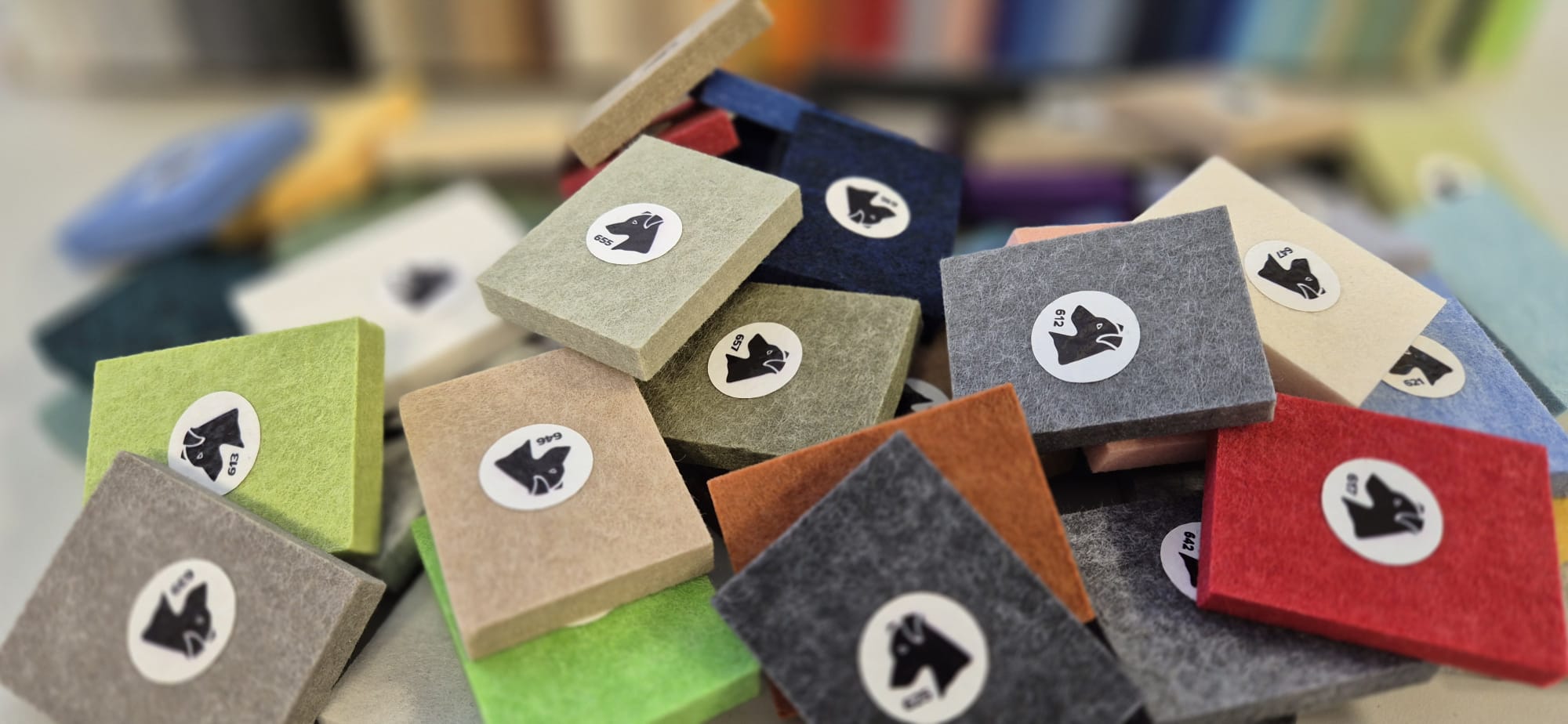
At first glance, PET felt looks simple enough: a light, sturdy panel with a soft texture, available in a wide range of colours. But behind that simplicity is a carefully controlled process that turns used PET packaging into something new - polyester fibre reimagined as a functional material for architecture and interior design.
PET felt can do several jobs at once: a finished surface, a sound absorber, and a design statement. It can wrap an entire wall, hang beneath a ceiling as an acoustic baffle, divide an open-plan office, or become part of a piece of furniture or a light fixture. That combination of performance and design freedom is exactly why it keeps showing up in modern offices, hotels, restaurants, schools, and other public spaces.
So what exactly is PET felt?
PET stands for polyethylene terephthalate - the material best known for drink bottles and other packaging, but also widely used to make polyester fibre. In PET felt, though, those fibres aren't woven like a conventional fabric. Instead, they're layered and bonded together under heat and pressure, forming a panel that's uniform, porous, and dimensionally stable.
The material Lola Acoustix works with contains 70 % recycled PET, per the material specification. Our standard 12 mm panel comes in a 1220 × 2440 mm format and weighs roughly 2,400 g/m². For projects that call for extra thickness, a bolder form, or different acoustic performance, we also offer a 24 mm version. With a palette of more than 50 colours, the material can sit quietly in the background or become the main visual statement in a space.
How does a PET bottle become a panel?
The exact process varies by manufacturer and by what the finished material needs to do, but the journey from packaging to panel generally follows the same key stages.
-
1. Collection and sorting
Used PET packaging is collected and sorted first. Caps, labels, leftover contents, and other plastics that could affect the quality of the recycled PET are removed from the stream. The quality of that input material directly affects the colour consistency, strength, and stability of the fibre produced later on.
-
2. Washing and shredding
Sorted bottles are thoroughly washed, then shredded into small PET flakes. Those flakes are further cleaned and dried to produce a raw material suitable for further processing.
-
3. Turning into fibre
The cleaned PET flakes are heat-processed and turned into a mass from which fine polyester fibres are drawn. Those fibres form the basis of the future panel. Their thickness and consistency are closely controlled at this stage, since they directly shape the look, density, and mechanical properties of the finished material.
-
4. Layering the fibres
The fibres are spread evenly and laid down in layers, creating a three-dimensional network with a huge number of tiny air pockets between the strands. That structure is exactly what gives the material its ability to absorb sound.
-
5. Heat bonding and pressing
The layers are then bonded into a solid panel under heat and pressure. Precisely controlling that process determines the panel's thickness, density, strength, and final texture. Once cooled, the panels are calibrated, cut to size, and checked before further processing.
The result isn't just recycled raw material in a new shape - it's a material engineered for long-term use indoors.
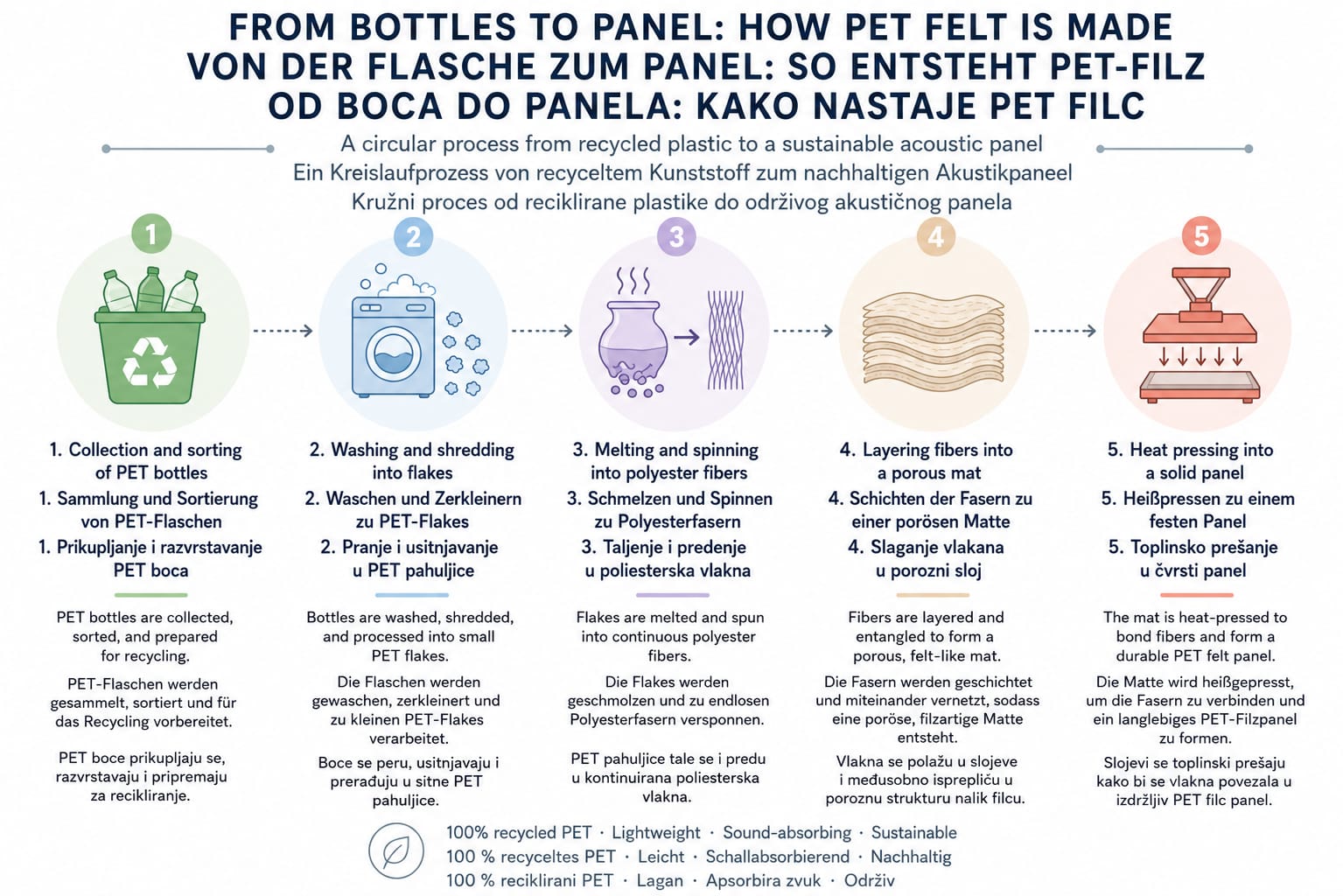
A circular process - from recycled plastic to a finished acoustic panel.
Why does PET felt absorb sound?
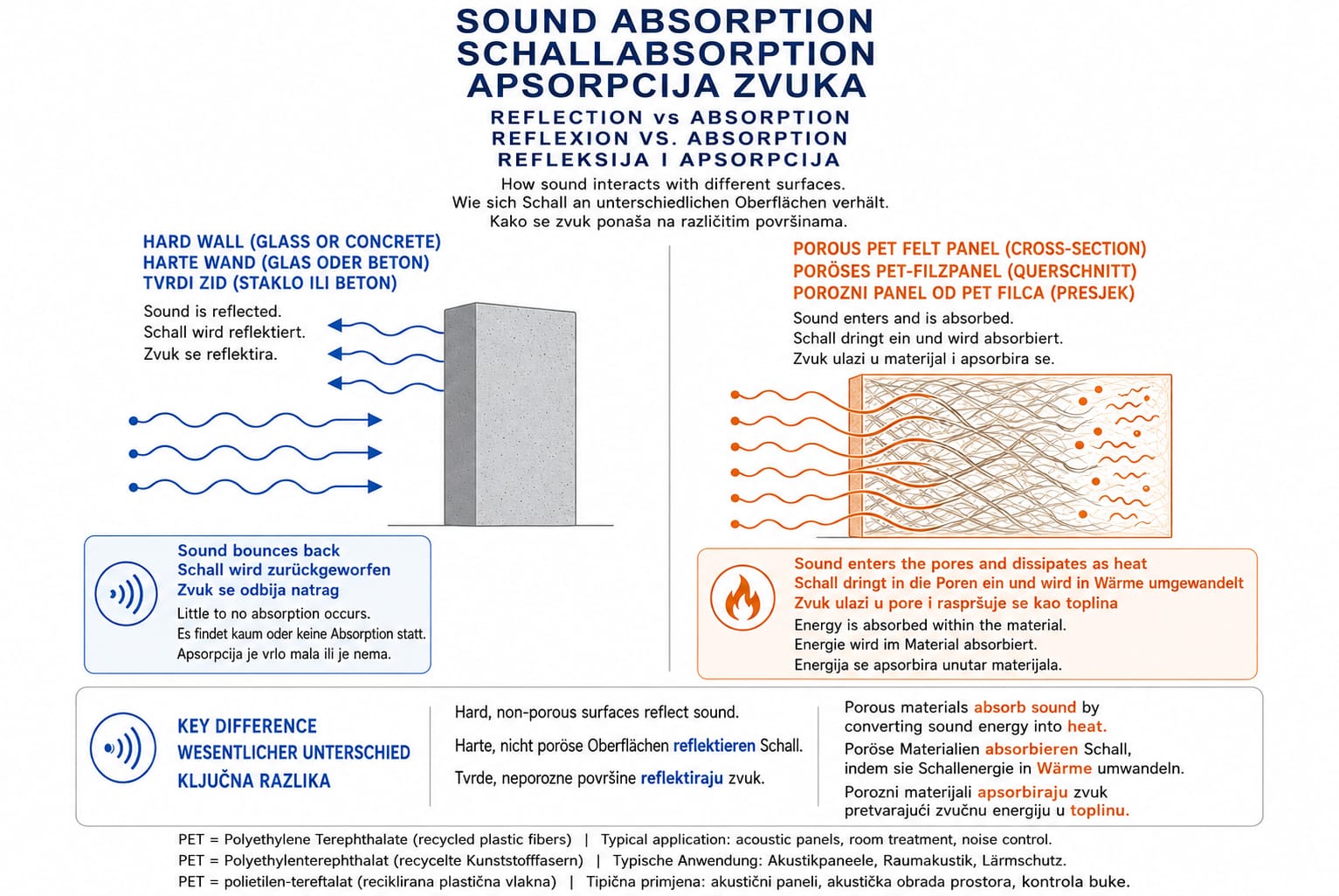
Sound travels through a space as a wave. When it hits a hard surface - glass, concrete, plaster, stone - much of that energy bounces straight back into the room. Repeated reflections build up as echo, extend reverberation time, and make speech harder to follow.
PET felt works differently. When a sound wave enters its porous structure, it sets the air moving between densely packed fibres. Friction and resistance inside the material convert a small part of that sound energy into a tiny amount of heat - meaning less sound bounces back into the room.
It's worth being precise about the difference between sound absorption and sound insulation. PET felt is primarily about reducing reflections, echo, and reverberation time inside a room. On its own, it isn't a structural barrier that stops sound travelling from one room to another - that requires the right wall, ceiling, floor, door, and junction construction.
The material itself is only part of the acoustic result. Thickness and density matter, as does the total area covered, the geometry of the element, where it's installed, and the air gap between the panel and the wall or ceiling behind it. That's why an absorption figure should always be read together with the exact configuration it was tested in.
What does the lab testing actually show?
Lola Acoustix has had its PET felt panels tested by independent laboratories. Because results are tied to the specific samples and mounting methods tested, we list the conditions alongside every figure.
Sound absorption - 12 mm PET felt
A 12 mm panel weighing roughly 2.32 kg/m² was tested to ISO 354:2003 in a reverberation chamber, mounted per Type E with a 200 mm air gap behind the panel.
That configuration measured:
- average sound absorption coefficient αs = 0.80 across 100–5000 Hz
- Noise Reduction Coefficient: NRC = 0.85
- weighted sound absorption coefficient αw = 0.90
- sound absorption class A per ISO 11654
Those are strong numbers - but they belong to that exact test setup. Mounting the same material flush against a wall, with a smaller air gap, or in a different geometry can produce a different result.
Sound absorption - 24 mm PET felt
A 24 mm panel was tested to SIST EN ISO 354 at Slovenia's Zavod za gradbeništvo (Building and Civil Engineering Institute). Mounted per E-200, with a 200 mm air gap behind the sample, it achieved a weighted sound absorption coefficient of αw = 0.85 H - sound absorption class B per SIST EN ISO 11654.
The same material was also tested as a free-standing element, which is relevant for room dividers. The results are a good reminder that with acoustic products, what matters is the whole element and how it's positioned - not just the thickness of the raw board.
Fire performance
12 mm PET felt, at 2,400 g/m², was tested to EN 13823 and EN ISO 11925-2 and classified under EN 13501-1:2018.
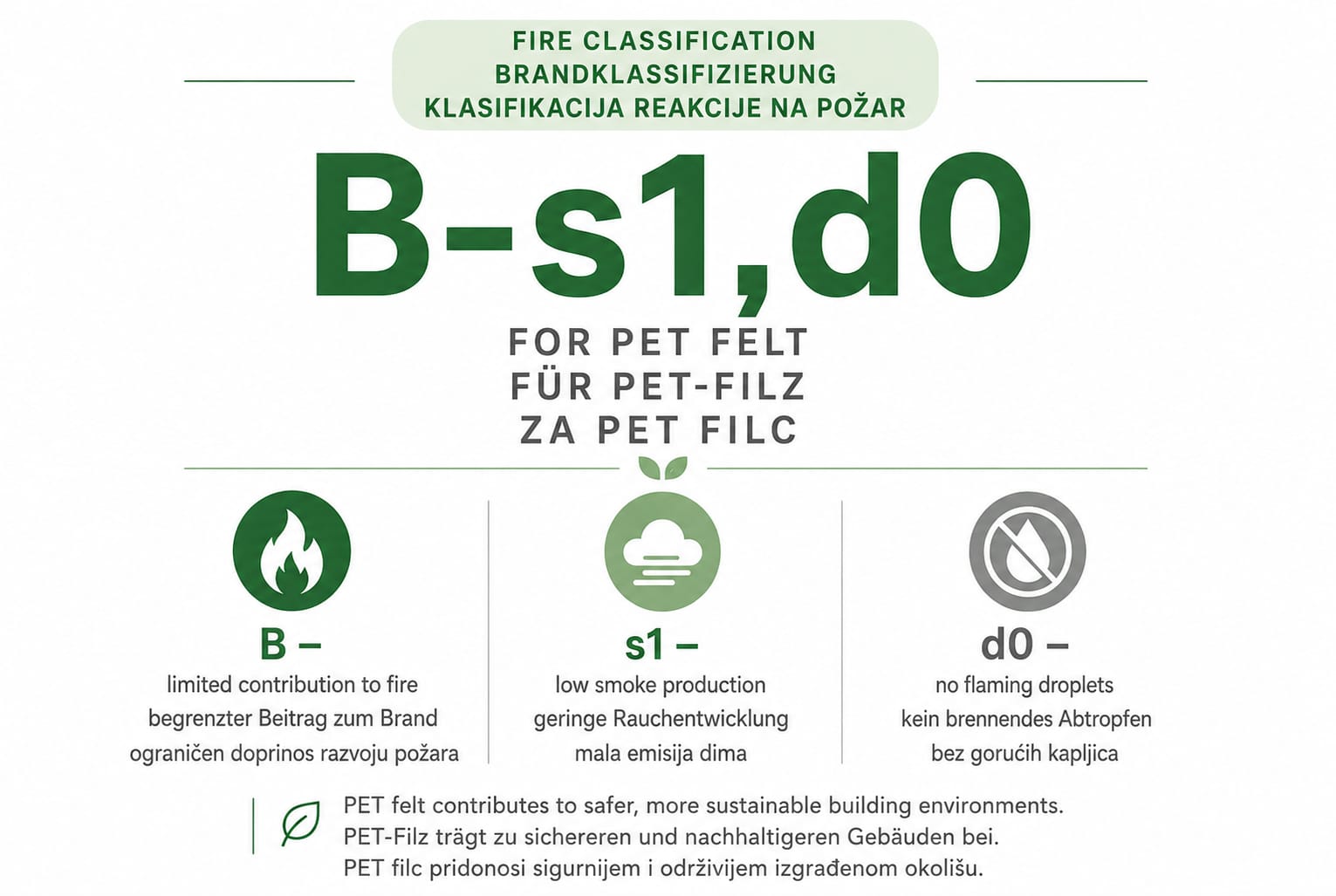
The tested sample achieved a B-s1,d0 classification:
- B - a very limited contribution to fire growth
- s1 - a low level of smoke produced during testing
- d0 - no flaming droplets or particles recorded during testing
That classification applies within the scope described in the report: the tested 12 mm product, mechanically fixed without joints to an A1- or A2-class substrate. For bonded, laminated, or multi-component builds, it's worth checking whether the existing classification actually covers the full assembly.
Formaldehyde emission
Formaldehyde emission was tested using a method referencing EN 717-1:2004. On the sample tested, formaldehyde wasn't detected above the lab's detection limit of 0.050 mg/m³.
The precise way to put that is "not detected at the 0.050 mg/m³ detection limit" - not a claim of an absolute 0 %. That phrasing gives specifiers a real, verifiable figure rather than an oversimplified read of the lab result.
All the reports referenced above are available in our Downloads section.
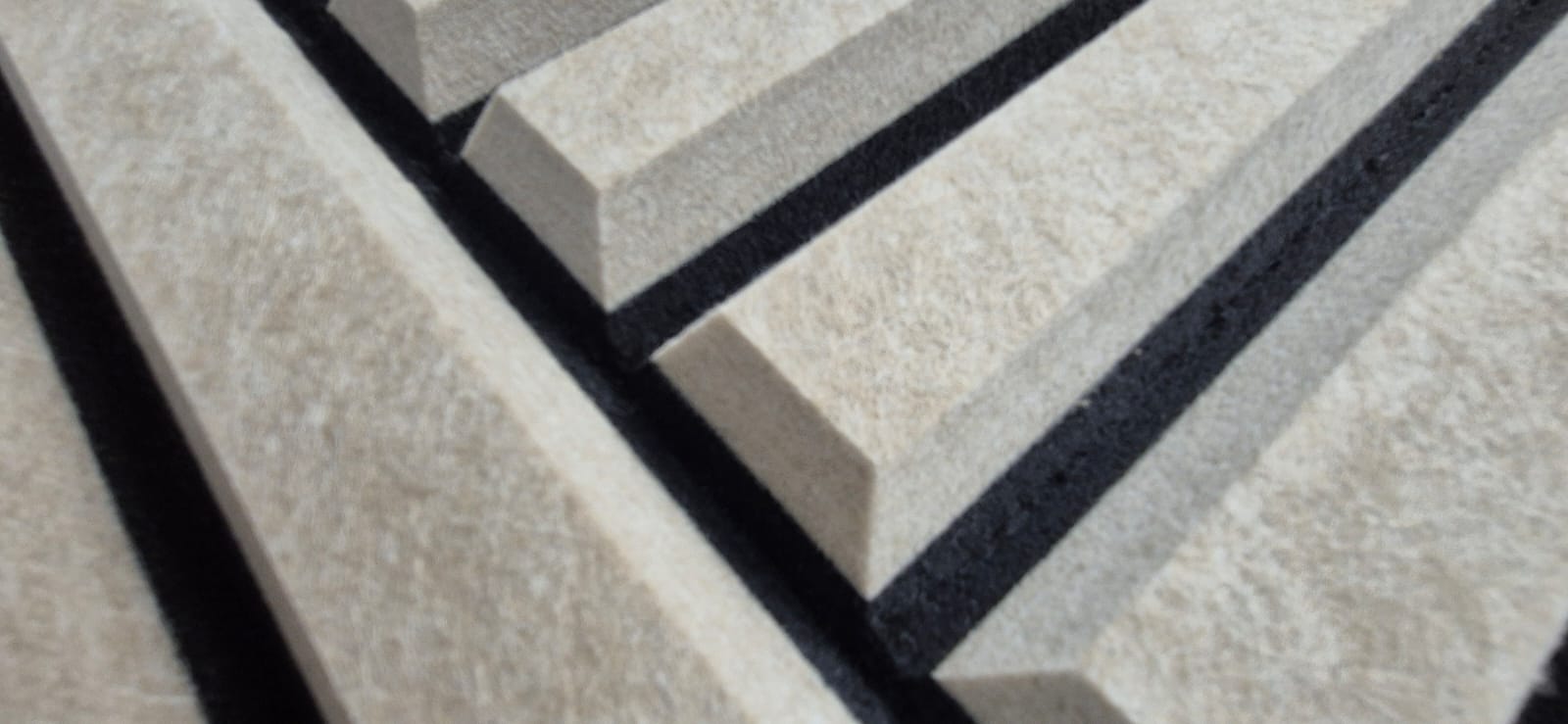
A material that gives architects room to work
Acoustic performance is only part of what PET felt can do. The board is light, easy to handle, and machines cleanly. It can be cut flat, routed, engraved, perforated, V-cut and folded into three-dimensional forms, bonded into thicker elements, or shaped in a vacuum press.
That's why the same base material can become a wall panel, a ceiling baffle, a room divider, a decorative feature, part of a piece of furniture, or an acoustic light fixture. Within the standard colour range, colour isn't a surface coating applied afterwards - it runs through the material itself, so cut edges and machined surfaces can stay visible as part of the design.
The material doesn't impose a fixed shape on the architect. It's a starting point for modular, parametric, or fully custom solutions built around a specific space, a brand identity, and the acoustic result that's actually needed.
Not all PET felt panels are the same
The name of the material alone doesn't tell you much. Two PET felt panels of the same thickness can differ in density, fibre structure, stiffness, and acoustic behaviour - and how they're processed and installed changes the end result even further.
So it's worth checking, before you specify:
- the thickness, format, and weight of the material
- the recycled content and the document that backs up that claim
- the standard the acoustic testing was carried out to
- the exact test configuration, especially the air gap behind the panel
- the fire classification and its scope of application
- whether a result applies to the raw material or the finished product
That kind of scrutiny protects both the designer and the client. It also means PET felt gets chosen for what it actually needs to do in a space - not just for its colour and pattern.
From material to solution
At Lola Acoustix, we treat PET felt as a starting point, not a finished product. We combine its acoustic performance with design, digital preparation, precision CNC machining, forming, and hands-on installation experience in real interiors.
Before we settle on a solution, we look at how the space is used and its volume, its hard surfaces, existing furniture, and the level of acoustic comfort it needs. Only then do we decide on the type of element, the quantity, and how it should be installed. For an early estimate, our acoustic calculator is a good starting point; more complex spaces get an individual concept.
So a PET bottle doesn't end its journey as waste. It becomes fibre, the fibre becomes a panel, and the panel becomes part of an interior that feels calmer, more comfortable, and unmistakably its own.
Want to see the material in person, browse the colour palette, or get technical documentation for a project? Send us an inquiry - together we can find a solution that works for the space and the people who use it.