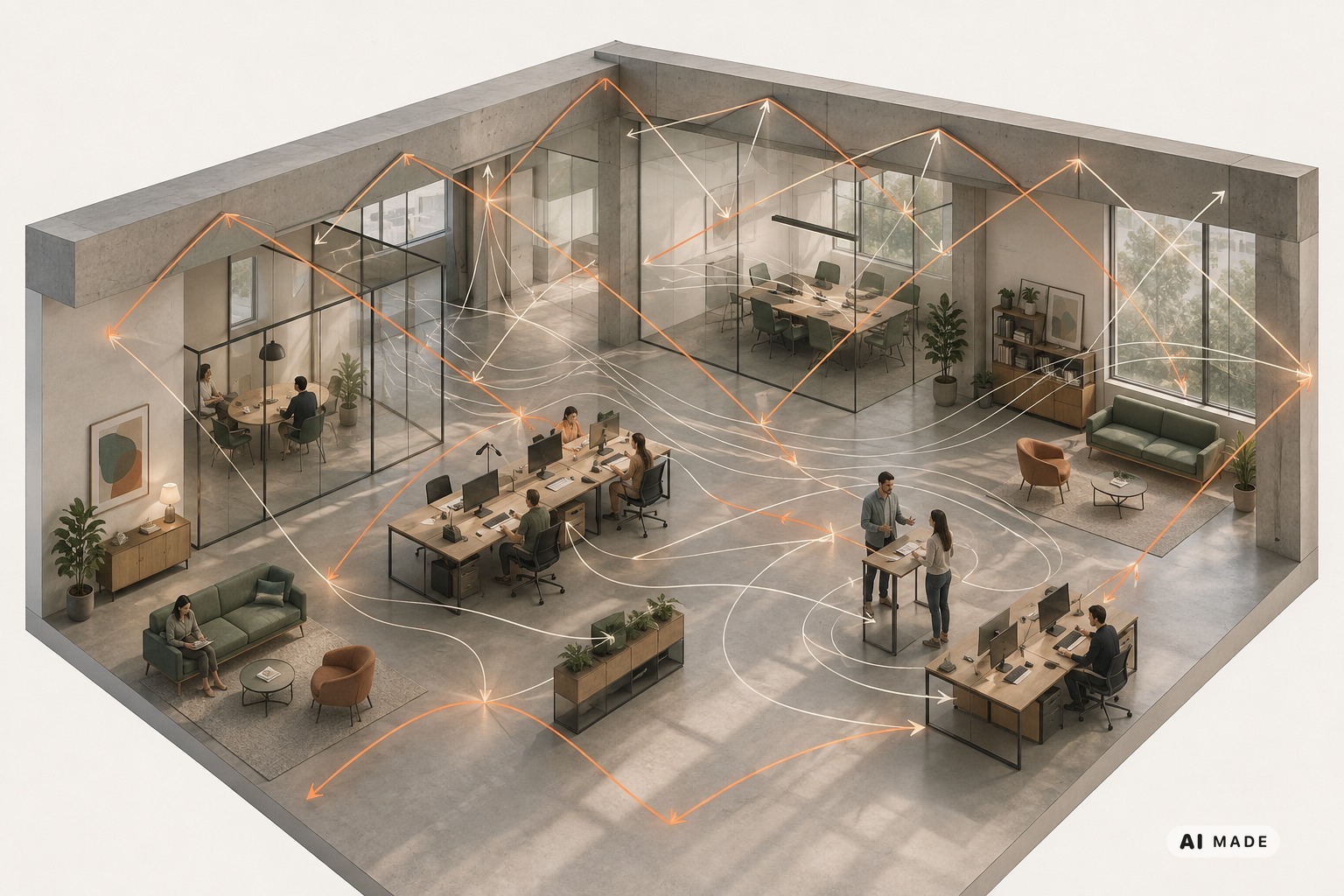
If you ask me what problem I hear most often from architects, designers, and owners of modern companies, the answer is almost always the same.
"The space looks perfect, but the moment three people are in it, the echo drowns out our own thoughts."
Over the years I've seen hundreds of spaces like this. Minimalist offices, open-plan layouts, modern conference rooms. Tens of thousands of euros go into premium furniture, concrete, glass partitions, and clean lines. Visually, it looks like it belongs on a magazine cover. But the moment teams start working, the problems begin. Running online meetings becomes impossible, employees end the day with noise-induced headaches, and an ordinary phone call disrupts half the office.
Why does this happen? Because hard surfaces are the perfect springboard for sound. It bounces relentlessly off them and creates the echo that makes a space unworkable.
One mistake I see all the time
Many clients panic, start searching online, and make one critical mistake right there - they confuse sound insulation with sound absorption.
They think they need to put up heavy plasterboard, tear down walls, or - worse - glue cheap, ugly foam onto the walls that completely ruins the premium design they paid so much for. What you actually need isn't insulation that keeps sound from leaving the room. You need a material that will "soak up" the echo inside the room itself - you need genuine absorption.
That's exactly why, at Lola Acoustix, we focus solely on a material that combines acoustic science with high-end design: PET felt.
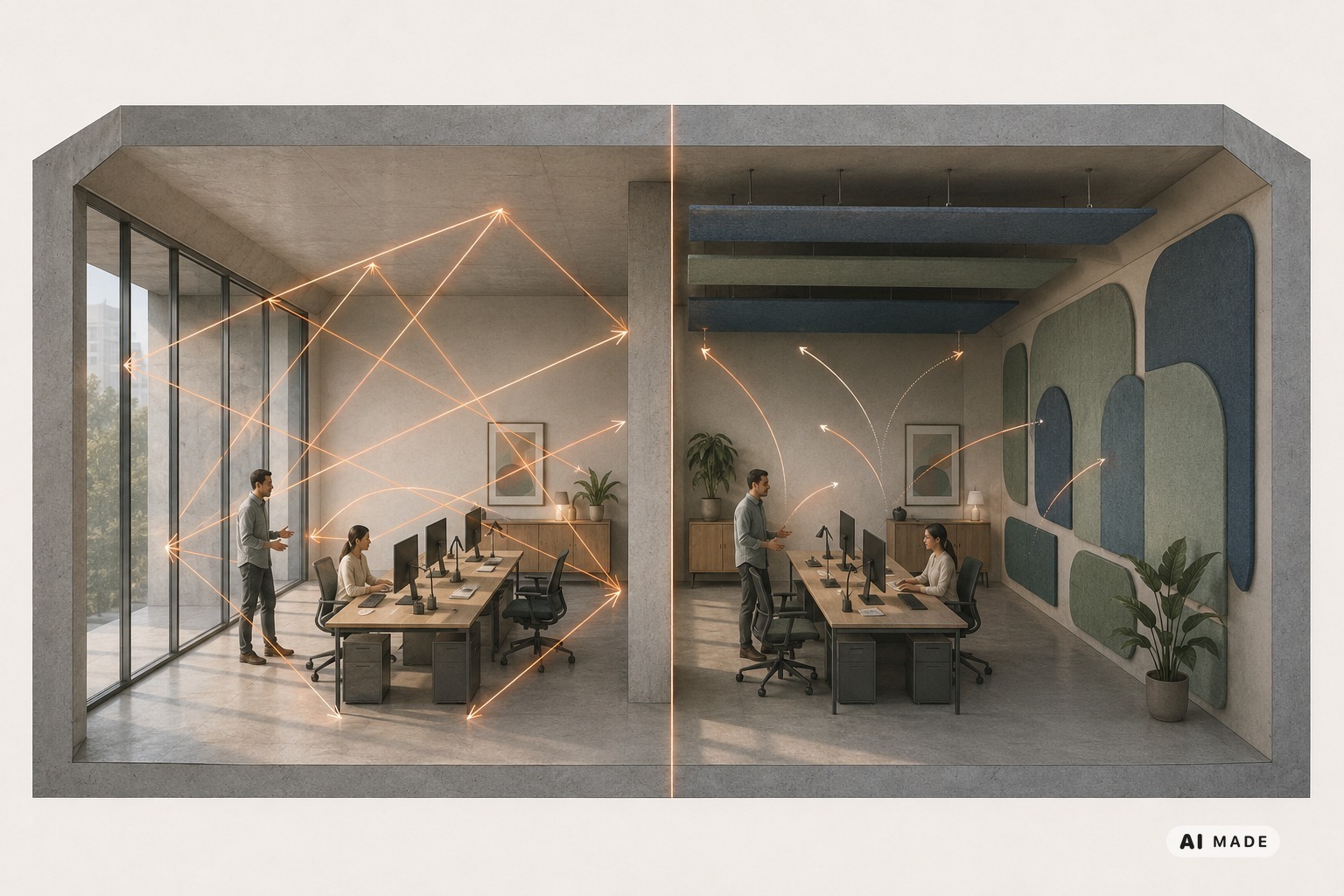
The same space, before and after acoustic treatment.
From plastic bottle to premium design
When I show clients a PET felt panel for the first time, few can believe that this soft, pleasant, textured material actually started out as plastic bottles.
The process is fascinating. Used packaging is washed, shredded into small flakes, and thermally converted into fine polyester fibres. Those fibres are then bonded under pressure. What we end up with (making up 70 % recycled material) is a panel with millions of tiny air pockets. When a sound wave hits that panel, it enters the structure, and friction simply turns the unpleasant echo into a negligible amount of heat.
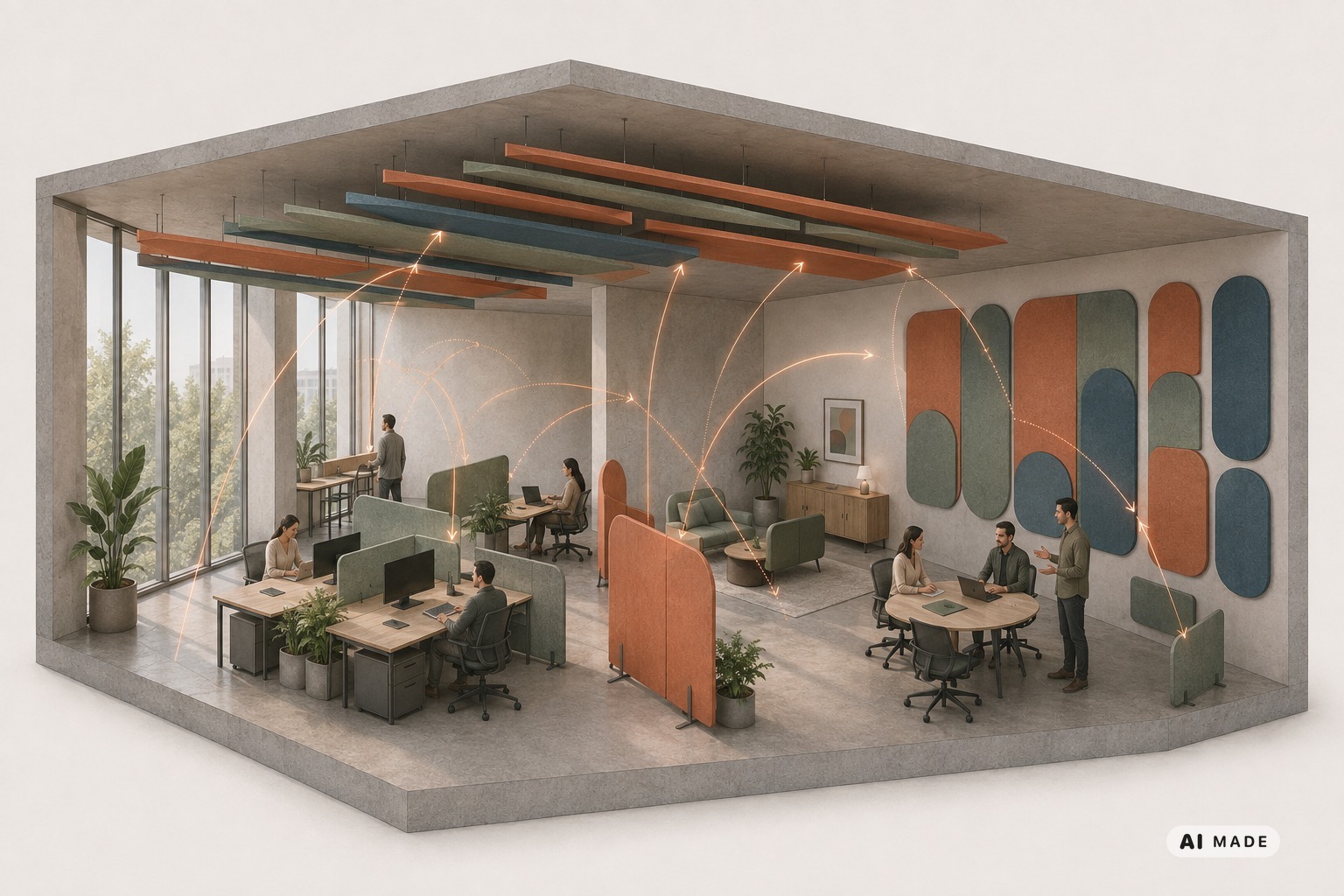
What to ask before choosing an acoustic solution
If I could give you just one piece of advice, it would be this: never buy acoustic panels based on a nice photo or a promise that they "absorb sound." Ask for evidence. In our industry, everything is measurable.
Before you decide, ask your supplier these three questions (these are also the standards Lola Acoustix panels are held to):
Your checklist:
-
What's the actual absorption class? Our 12 mm panels are tested to ISO standards (ISO 354:2003 and ISO 11654) and achieve an absorption coefficient of αw = 0.90, placing them in the highest Class A.
-
Is the material fire-safe? This is critical for commercial spaces. Our panels carry a B-s1,d0 certification, meaning a very limited contribution to fire spread, no flaming droplets, and minimal smoke.
-
Are there any harmful emissions? Check the formaldehyde level. On our panels, it simply isn't detected (below the detection limit of 0.050 mg/m³).
So what have we learned? Where do you start?
Solving echo doesn't have to mean compromising on design. But the most important thing is not to make the decision purely by browsing an online catalogue, sight unseen.
My recommendation? Always start by looking at real, completed projects. Take a look at our completed projects - seeing real spaces will give you an instant sense of vision and inspiration for your own interior.
And once you've seen what's possible, you can experience the material in person too. We're always happy to host clients at our showroom in Zagreb (Buzinski krči 5, inside City Island). There you can feel the texture of PET felt first-hand, hear the difference in the room, and take your time choosing the right thickness and shade.
Curious what this looks like in practice? Explore completed projects or send us an inquiry and take the first step toward perfect acoustics.